
Injection site reactions on a GLP-1: what is normal and what helps
From the Belle care team · Updated
A red spot after your shot? It is usually normal.
Redness, itching, a small bump or a bruise where you inject is called an injection site reaction. This guide explains why it happens, what normal looks like, how to make your shots more comfortable, and when to reach out.
- It can happen with any shot. Insulin, vaccines, B12 and GLP-1s can all cause it.
- It is not a sign your medicine is bad. It is your body reacting to something being injected.
- Most reactions fade on their own and often get milder as your body gets used to your shots.
Part 1: Why it happens
It is not your medicine. It is your immune system (your body's defense system). When a needle goes through your skin and medicine is placed under it, your body notices. Your immune system sends extra blood flow and immune cells to the spot to check it out and start healing. That is what causes the redness, warmth, swelling and itch.
This is a normal, local response to being injected. It is not usually caused by an additive or something wrong in your medicine. People get the same kind of reaction from insulin, vaccines, allergy shots, B12 and many other injectable medicines.
- The needle itself. Any needle makes a tiny wound. Your body responds the way it does to a small scrape, with a little redness and swelling while it heals.
- Fluid under the skin. The medicine takes up space in the tissue until your body absorbs it. That can feel like a small bump or pressure for a short time.
- Histamine release. Immune cells in your skin release histamine, the same chemical behind a bug bite. That is why the spot can itch and look pink or raised.
- A tiny blood vessel. If the needle nicks a small vessel, a little blood collects under the skin. That is a bruise. It is harmless and fades on its own.
Part 2: What is normal
Know what to expect so you can worry less. Here is what common, mild reactions can look like. These photos are from other injectable medicines, because the reaction looks the same no matter what was injected.
Redness and swelling (usually normal)
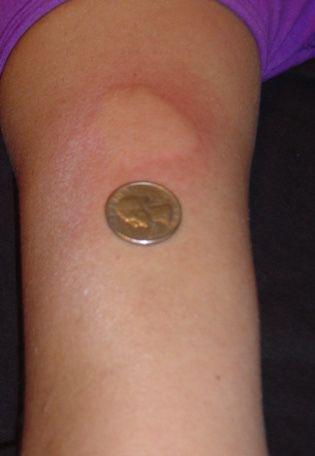
A pink or red, slightly raised patch. It may feel warm or itchy. The coin is a quarter, so this patch is about 2 to 3 inches across. Photo: Embowafa34, public domain, via Wikimedia Commons. Reaction to a non-GLP-1 shot.
A soft bump the next day (usually normal)
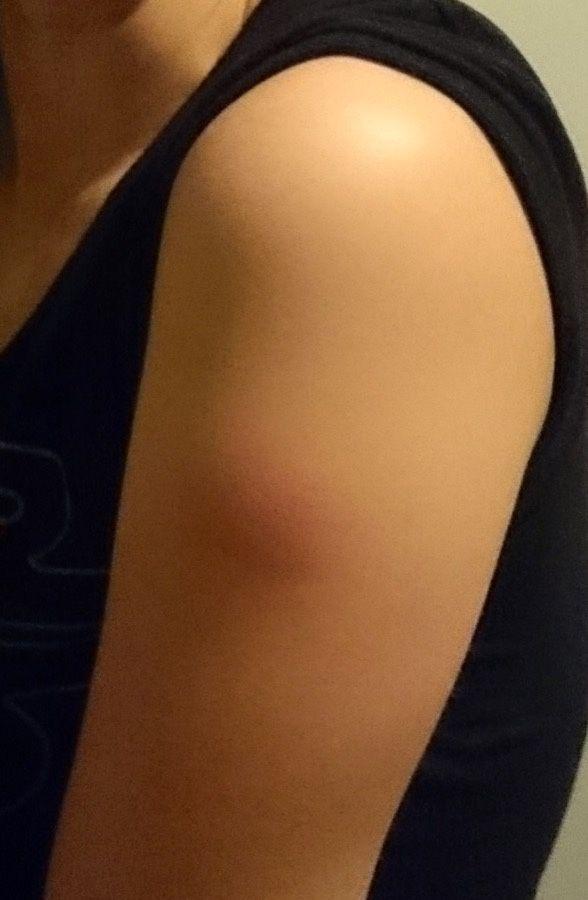
A pink, tender bump that shows up within a day of the shot. It often feels a little firm and sore when you press on it. Photo: Fluffychen, CC BY-SA 4.0, via Wikimedia Commons. Day after a tetanus shot.
A bruise (usually normal)
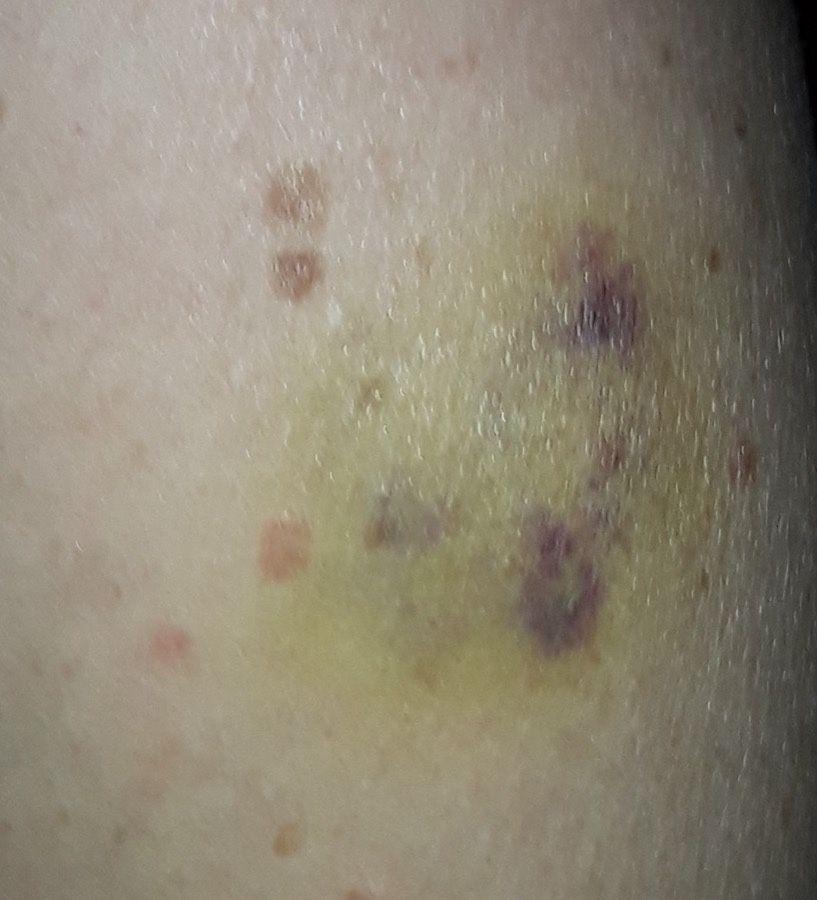
A purple or blue spot that turns green, then yellow, as it heals. This one is 6 days old. Bruises can take up to 2 weeks to fade. Photo: Oogle12, CC BY-SA 4.0, via Wikimedia Commons. Six days after a vaccine.
A small lump under the skin (usually normal)
A pea-sized lump (about the size of a pea to a grape) that you can feel more than see. Your shot goes into the fat layer just under the skin, above the muscle, and the lump is the medicine sitting there while your body absorbs it. It usually goes away in a few days. If the same spot stays lumpy, move your shots somewhere else.
On darker skin, redness may look purple, brown or darker than the skin around it rather than red. Swelling, warmth and itch are often easier to notice than color.
How a normal reaction plays out
- Minutes to hours: sting or a small red dot. A brief sting, a pinprick of blood or a small pink spot.
- Day 1 to 2: it may peak. Redness, warmth, itch, swelling or a tender bump can be at their most noticeable.
- Day 3 to 7: fading. It should look and feel better each day. Itch is often the last thing to go.
- Up to 2 weeks: bruises finish healing. Bruises change from purple to green to yellow, then disappear.
Part 3: Before and during your shot
Small changes make gentler shots. How you prepare and inject makes a real difference. Most people who get reactions see them shrink once they use these steps every week.
For step-by-step injection directions, see How do I store, handle, and inject my GLP-1 medication?.
1. Rotate where you inject: at least 1 inch from your last spot
Using the same spot over and over is one of the most common reasons for reactions and lumps. Give each spot time to heal before you use it again.
- Use all your areas. Belly, front or outer thigh, and the back of your upper arm all work. Follow the areas listed for your medicine.
- Move at least 1 inch (about 2 finger widths) from your last shot, even in the same area.
- Keep a simple log. A note on your phone with the date and spot is enough.
- Skip skin that is not healthy. Stay away from bruises, scars, stretch marks, moles, tattoos and any spot that is still red or lumpy.
2. Prepare your medicine and skin
Cold medicine and wet alcohol are two of the biggest causes of sting. A few minutes of prep helps.
- Let your dose warm up. Draw up your dose first, then let the filled syringe sit at room temperature for about 15 to 20 minutes before your shot. Put the vial right back in the fridge. Never microwave your medicine or run it under hot water.
- Let the alcohol dry. Clean the spot with an alcohol swab, then wait about 30 seconds until it is fully dry. Injecting through wet alcohol stings and irritates the skin.
- Numb it first, if you like. Hold an ice cube or cold pack on the spot for 1 minute, or use a numbing cream (see Part 4). Dry the skin and clean it after.
- Use a new needle every time. Needles get dull after one use. A dull needle tears more skin and hurts more. Never reuse a needle or syringe.
3. Inject gently: slow and steady
Your technique matters. A relaxed, slow shot is a more comfortable shot.
- Relax the area. Sit down and let the muscle go soft. Tense muscle makes shots hurt more.
- Pinch up a fold of skin if your instructions say to, so the medicine goes into fat, not muscle.
- Go in quickly, push slowly. Insert the needle in one smooth move, then push the medicine in slowly over several seconds.
- Hold it in place. Count to 10 before you pull the needle out, so medicine does not leak back onto the skin.
Part 4: Relief
Already itchy or sore? These over-the-counter products can ease redness, itch, pain and bruising. Start with a cold pack. Add one product at a time based on what bothers you most.
A. Cool it down
Cold is the simplest fix and helps almost every symptom. It calms swelling, itch, redness and pain, and can limit bruising. Use cold for the first 1 to 2 days.
Cold compress, start here. Look for a reusable gel pack, a bag of frozen peas, or ice in a zip bag.
- How to use: wrap it in a thin towel and hold it on the spot for 10 to 15 minutes. Repeat a few times a day.
- Works in minutes.
- Tip: never put ice right on bare skin.
Warm compress, for bruises only, after 48 hours. Look for a microwavable heat pack or a warm, damp washcloth.
- How to use: once a bruise is 2 days old, gentle warmth can help it fade faster. Use it for 10 to 15 minutes a few times a day.
- Works in: helps a bruise clear over several days.
- Caution: do not use heat on a spot that is red, hot or swollen. Use cold instead.
B. Calm itching and redness
Itch comes from histamine, so anti-itch creams and antihistamines help. Try not to scratch. Scratching makes the spot angrier and can break the skin.
Get reactions every week? Ask your care team if you can take a non-drowsy antihistamine the morning of your shot to head it off.
Hydrocortisone 1% cream (anti-itch cream), gentle. Look for Cortizone-10 or store brand "hydrocortisone 1%."
- How to use: a mild steroid cream that calms itch, redness and swelling. Rub a thin layer on the spot 1 to 2 times a day.
- Works in a few hours.
- Tip: use it only after your shot, not before.
- Caution: do not use on broken skin. Stop after 7 days and message us if it is not better.
Cetirizine 10 mg, loratadine 10 mg or fexofenadine 180 mg (non-drowsy antihistamine), once a day. Look for Zyrtec, Claritin, Allegra or store brand allergy tablets.
- How it works: allergy pills that block histamine all over the body, so they ease itch and swelling from the inside. Pick one and take it once a day.
- Works in 1 to 3 hours.
- Watch for: cetirizine can make some people a little sleepy.
- Caution: ask first if you are pregnant or breastfeeding, or have kidney or liver disease.
Diphenhydramine 25 mg (antihistamine that causes drowsiness), night only. Look for Benadryl or store brand "allergy" with diphenhydramine.
- How it works: strong itch relief that also makes you sleepy. Best saved for bedtime if itch keeps you awake.
- Works in 30 to 60 minutes.
- Watch for: grogginess the next morning, dry mouth.
- Caution: do not drive after taking it. Do not mix with alcohol or sleep aids. Ask first if you are over 65.
Calamine lotion or pure aloe vera gel (skin lotion), gentle and soothing. Look for Caladryl Clear, store brand calamine or fragrance-free aloe gel.
- How to use: cools and soothes itchy skin. A good choice between doses of hydrocortisone. Keep aloe in the fridge for extra cooling.
- Works in minutes.
- Tip: pick fragrance-free to avoid more irritation.
C. Ease soreness and sting
For a sore, tender spot, a pain reliever can help. If the shot itself is what bothers you, a numbing cream before you inject can take the edge off.
Lidocaine 4% cream (numbing cream), before your shot. Look for LMX 4, Aspercreme with Lidocaine or store brand "lidocaine 4%."
- How to use: rub a small amount on the spot about 30 minutes before your shot. Wipe it all off, then clean with alcohol and let it dry before you inject.
- Works in 20 to 30 minutes.
- Tip: use a coin-sized area only.
- Caution: use only on healthy, unbroken skin. Do not cover it with a heat pack.
Acetaminophen (pain reliever), gentle on the stomach. Look for Tylenol or store brand "acetaminophen." It eases soreness without upsetting your stomach, which is helpful if your GLP-1 already makes you queasy (see our nausea guide).
- How much: a typical dose is 500 to 1,000 mg.
- Works in 30 to 60 minutes.
- Limit: no more than 3,000 mg in 24 hours unless your care team says so.
- Caution: many cold and flu products also contain acetaminophen. Count those too. Ask first if you have liver disease or drink alcohol daily.
Ibuprofen or naproxen (NSAID pain reliever), helps swelling too. Look for Advil, Motrin, Aleve or store brand. It eases pain and also calms swelling. These can upset your stomach and may add to heartburn (see our heartburn and acid reflux guide).
- How much: a typical dose is 200 to 400 mg of ibuprofen, or 220 mg of naproxen.
- Works in 30 to 60 minutes.
- Tip: take with food. It can upset an empty stomach.
- Caution: ask first if you have kidney disease, stomach ulcers or heart disease, take a blood thinner, or are pregnant.
D. Help bruises fade
Bruises are harmless and heal on their own. Cold in the first 2 days and warmth after that is the main plan. Some people also like these.
Arnica gel (topical gel), optional. Look for Arnicare Gel or store brand arnica gel.
- Why: a plant-based gel many people use for bruises. Research on how well it works is mixed, but it is low risk on unbroken skin.
- How to use: a thin layer, up to 3 times a day.
- Caution: for the skin only. Do not use on broken skin and never take arnica by mouth.
Putting it together: your shot-day plan
This is a general plan. Your care team may give you one that fits you better.
- Prep, 30 minutes before. Draw up your dose and let the filled syringe sit at room temperature for 15 to 20 minutes. Pick a new spot. Add numbing cream or plan to ice if shots sting.
- Inject gently. Dry alcohol, relaxed skin, a new needle, a slow push, and a count of 10 before you pull out.
- Right after: hands off, ice on. Do not rub. Ice for 10 minutes if you tend to react. Wear loose clothes.
- Next 1 to 3 days: treat and watch. Cold packs, hydrocortisone or an antihistamine for itch. Trace the edge if you are not sure it is shrinking.
Part 5: When to get help
Know the red flags and act fast on them. Most reactions are mild and go away on their own. A few signs point to an infection or an allergic reaction, and those need care. Do not stop your GLP-1 on your own. Your care team can help you decide what to do next.
Message your Belle care team the same day if
- Redness keeps spreading or growing after 48 hours, or moves past the line you drew.
- The spot gets hot, more painful or more swollen instead of better.
- You see pus or cloudy drainage, or red streaks moving out from the spot.
- You have a fever of 100.4°F or higher or chills along with a red, sore spot.
- You see a blister, an open sore, or skin that turns dark purple or black.
- The reaction is larger than the palm of your hand, or lasts longer than 1 week.
- A hard or painful lump does not go away after 2 weeks.
- Your reactions are getting bigger with each dose, or you get hives near the spot.
Send photos with your message. Pictures from the first day and today help us see what is changing.
Need to reach us? See how to contact Belle.
Related guides
- How do I store, handle, and inject my GLP-1 medication?
- Heartburn and acid reflux on a GLP-1: why it happens and what helps
- Nausea on a GLP-1: why it happens and what helps
- Constipation on a GLP-1: why it happens and what helps
- Losing weight slowly on a GLP-1: why it happens and what helps
Photos via Wikimedia Commons: "Copaxone Injection Site Reaction" by Embowafa34 (public domain); "Tetanusimpfung, Tag danach" by Fluffychen (CC BY-SA 4.0); "Moderna arm bruise six days after second injection" by Oogle12 (CC BY-SA 4.0). Photos were resized.
More in GLP-1
- Losing weight slowly on a GLP-1: why it happens and what helps
- Nausea on a GLP-1: why it happens and what helps
- Why does my medication look different between shipments?
- Which syringe and needle do I use, and what if something goes wrong when I draw or inject?