
Dosing
How to request a dose change (increase or decrease)
Updated Oct 2, 2026From the Belle care team
Dose changes are clinical decisions you make together with your provider, so there is no dose change button in the portal. Requesting one takes about a minute through chat, and your provider reviews every request.
Steps
1. Open Chat
Sign in to your portal and select Chat in the menu, or use the chat bubble in the corner of any page.
2. Tell us what you want and why
A short message is all we need, along with your current dose. For example: "I am on 5 mg and would like to increase to 7.5 mg. My appetite has come back over the last two weeks." If you want to decrease, or stay at your current dose instead of stepping up, say that the same way. Please mention any side effects you are having, since that helps your provider decide safely.
3. Your provider reviews
Your care team routes the request to your provider. You will get a reply in the same chat thread. Patients stay at a dose for a minimum of four weeks, and any increase is subject to provider approval.
4. See the change in your portal
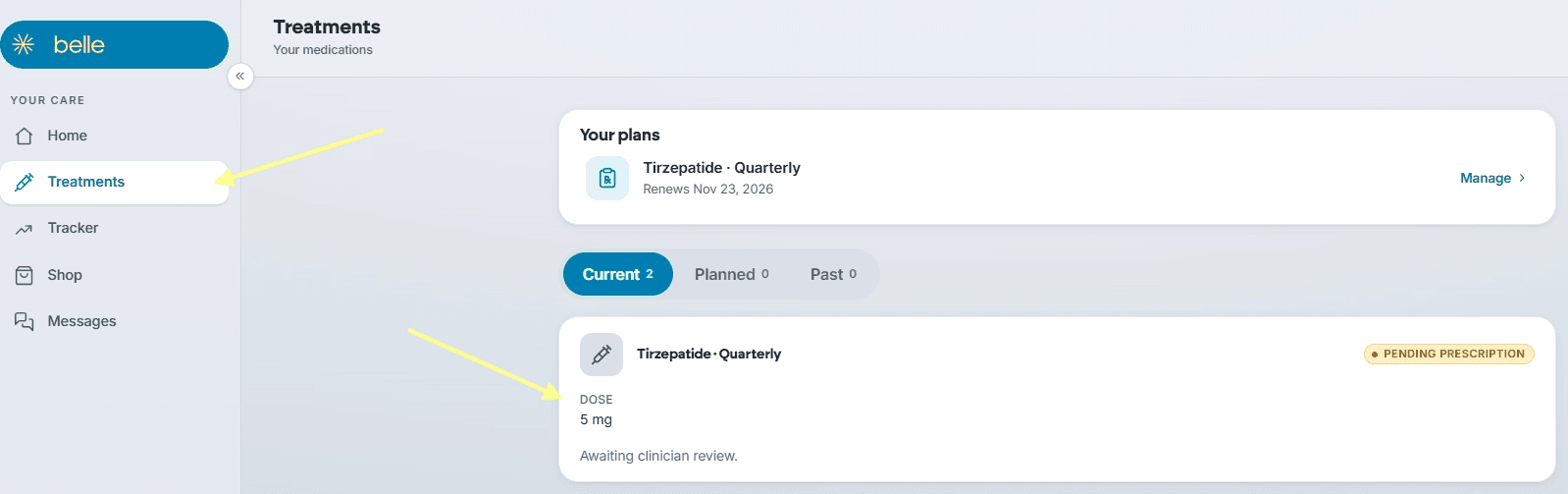
Once approved, your plan page in the new Belle portal shows the new dose under Planned dose with its start date, and your Renewal starting dose updates. Your new prescription appears under the Planned tab on the Treatments page.
When to ask for an increase, and when not to
A request makes the most sense when your weight loss has plateaued, side effects have settled, and cravings or food noise are returning. If you have no side effects and your current dose is no longer doing enough, it is appropriate to ask about the next dose level. Your provider reviews every request, including your symptoms, weight trend, and recent gain.
- Close to your goal? There is no pressure to increase. Stay at the lowest dose that is working for you.
- A couple of pounds of weight gain does not automatically need a higher dose. Check calorie intake, protein, hydration, and exercise first. If those are solid, your provider may suggest a gradual increase, then maintaining at the lowest effective dose.
- Wanting to stay on your current dose longer, for example 8 weeks across two prescriptions before moving up, is fine. Just let us know.
- Want an increase but worried about side effects? Tell us in your message. Your provider can adjust the plan around how you have been feeling.
- Increase or switch medication? Whether to increase your dose or change to a different GLP-1 is a decision your provider makes after reviewing your full chart.
- If you are on semaglutide and want to move from 0.5 mg to 1 mg after 4 weeks, you can ask for it. You will go through your supply faster, so message us so your next shipment matches.
Timing matters
Once a shipment has been processed, a dose change cannot be applied to that order. Send your request with enough lead time before your next shipment date. If you want to avoid receiving a dose you are about to change, you can pause your plan or delay your next shipment while the change is reviewed.
If you increase sooner than scheduled, your current vial will run out before your next shipment arrives.
How long it takes: provider review usually takes 1 to 2 business days. The pharmacy fills the order 2 to 5 business days after approval, and most orders arrive 5 to 10 business days after provider approval. Once approved, your treatment plan updates for your next order, usually within 1 to 2 business days.
Higher dose, same supply: a dose increase does not by itself add medication to what you already have. A higher dose uses your supply faster, so you will need your next refill sooner. If you think you will run short, message us before your next scheduled renewal and we can move your refill date earlier, or delay it if you need more time.
If you have an approved increase but are afraid of running out, keep taking your current dose if it is working well. The clinic will send a new prescription at the higher dose, and you do not have to increase just because you have it.
Do I need to pause while I wait? No. If you are on an increasing plan, your next renewal already includes the increase. A pause or delay is only useful if you want to stop a shipment at a dose you are about to change.
Before your next order, confirm your desired dose with your care team and make sure it is updated in your plan so you do not run short.
Order holds: to delay a shipment, we need to confirm your current dose with your provider first.
Portal asks for payment when you request an increase? Message the care team. They will review your request, update your treatment plan, and ask you to retry payment once it is approved.
Changing your dose with your current supply
You can take less than your prescribed dose. Use Belle's dosage calculator to work out the units for the smaller dose, using the concentration printed on the vial you are using now, because that can change between shipments (see "How do I use Belle's dosage calculator?"). If you want to take more than your prescribed dose, message us first and we will confirm it with your provider before you inject. Never take more than your prescribed dose without your provider's approval.
Taking less than prescribed, or stepping down
Taking less than your prescribed dose is okay. If you want to take more, message your care team first. If side effects are hard to manage, a smaller amount is a reasonable first step. To find the number of units for a smaller dose, use Belle's dosage calculator with the concentration (mg/mL) printed on the vial you are using now. The same number of units is a different dose in a different vial, so never reuse a unit count from an old vial. Let your care team know you have lowered your dose so your plan and records match.
- Common reasons to step down: nausea, loss of appetite, heartburn, indigestion, or diarrhea after an increase, or losing weight faster than intended along with digestive symptoms. Nausea after an increase often means the new dose is a bit too high. You can go back to your previous dose, or try a smaller in-between step later.
- Check the basics first: food, hydration, protein, and your eating pattern can all cause nausea. Ask your care team whether an anti-nausea medicine is a good option for you.
- Stepping down gradually: lower one small step at a time and stay at each lower dose for about 2 weeks before the next one. Use Belle's dosage calculator to find the units for each step on your current vial. Microdose plans at lower set doses are also available (see "What is microdosing a GLP-1?").
- Staying lower is fine. The goal is the lowest dose that works for you without side effects that get in the way.
- Going up again later: when you feel ready, message us and your care team can help you increase more slowly. Wait about 4 weeks before judging how a dose change is working.
- Already lowered on your own? That is okay. Let the clinic know how you are doing on the lower amount so your plan can match.
- After reaching goal weight, you can ask to move to a lower maintenance dose. Your provider reviews and updates your plan.
If your symptoms are severe or you cannot keep fluids down, contact your care team right away.
Going up more slowly
You do not have to take the full next step. Ask your care team for a slower climb. A smaller step, or an in-between amount, is available when you are worried about side effects. Your provider can write the plan with smaller increases, or prescribe the next dose level and tell you exactly how many units to draw for a smaller amount. They will confirm the amount for your vial's concentration, because units vary and milligrams are the standard measure.
- Examples at a given vial concentration: on an 18 mg/mL tirzepatide vial, 6.5 mg is 36 units. On a 10 mg/mL vial, 3 mg is 30 units. Your vial may be different, so always use the units your care team gives you.
- If the next step is a big jump, your care team can offer a slower titration, and the plan can move more slowly than the standard schedule.
- Staying put when side effects are mild: for example, if you only have reflux in the first couple of days after each injection, staying at your current dose longer before increasing is usually better than increasing.
Dosing should still follow the step-up ladder. Please do not skip steps or take more than your prescribed dose without asking your care team. Tell your care team what you are planning so your plan and records match. See "How does dosing and dose increases work for GLP-1s?" for the ladder and maximum doses.
Good to know
- Dose changes apply to future shipments. Medication you already have keeps its original Directions unless your provider tells you otherwise.
- Wanting to stay at the same dose is a request we handle the same way. Just message us.
- If your portal shows a dose that does not match what you expect, message us and we will check your chart.
Restarting after a break or after side effects
After a break, restart lower and step back up every 4 weeks. After more than 8 weeks off, you restart at the starting dose. After 4 to 8 weeks off, you restart at least one step lower than your previous dose. Jumping straight to a higher dose, even one you tolerated before, raises the chance of severe stomach side effects. See "What if I miss my scheduled injection day?" for the full restart guidance.
If you stopped because of side effects, schedule a call with a provider to talk through what happened and plan how to move forward, including which lower dose to restart on. When you message us, please include the date and dose of your last injection and what symptoms you had, so your provider can decide whether to restart at the same dose or a lower one.
Keeping your plan and records right, and speaking with a provider
If you take a different amount than your records show, message your care team with the dose you actually take and the date you started it. They will review it and update your plan and portal to match. Your next renewal is based on your plan, so this keeps you from getting the wrong dose or running short.
Want to talk with a provider before your renewal? Use the provider consult link in your account to schedule a call. This is a good option if your dose is not working as expected, you are hesitant to increase because of side effects, or you are not sure whether to change your dose or switch medications.
Related articles
- How to find your dose and how many units to inject
- Refills, reorders, and renewals: how your next shipment works
Was this article helpful?