
A smaller body needs less fuel
You burn fewer calories at a lower weight. The amount you eat that once led to steady loss may now just hold your weight where it is.
Almost everyone on a GLP-1 hits a stretch where the scale stops moving. This guide explains why it happens, how to tell a real plateau from a slow week, and what you can do about it, from your plate to your care team.
Enter your email and we'll send the PDF straight to your inbox.

Tiffany Bailey, PA-CDirector of Patient Education, Belle
As you lose weight, your body changes how it uses energy and how it signals hunger. These changes are normal. Loss is usually fastest in the first months, then slows. That is how these medicines are expected to work, not a sign they stopped working.
You burn fewer calories at a lower weight. The amount you eat that once led to steady loss may now just hold your weight where it is.
After weight loss, your body can burn a little less energy and turn up hunger signals to protect its stores. This is called metabolic adaptation.
As side effects fade and you feel more like yourself, portions, snacks and drinks can creep back in without you noticing.
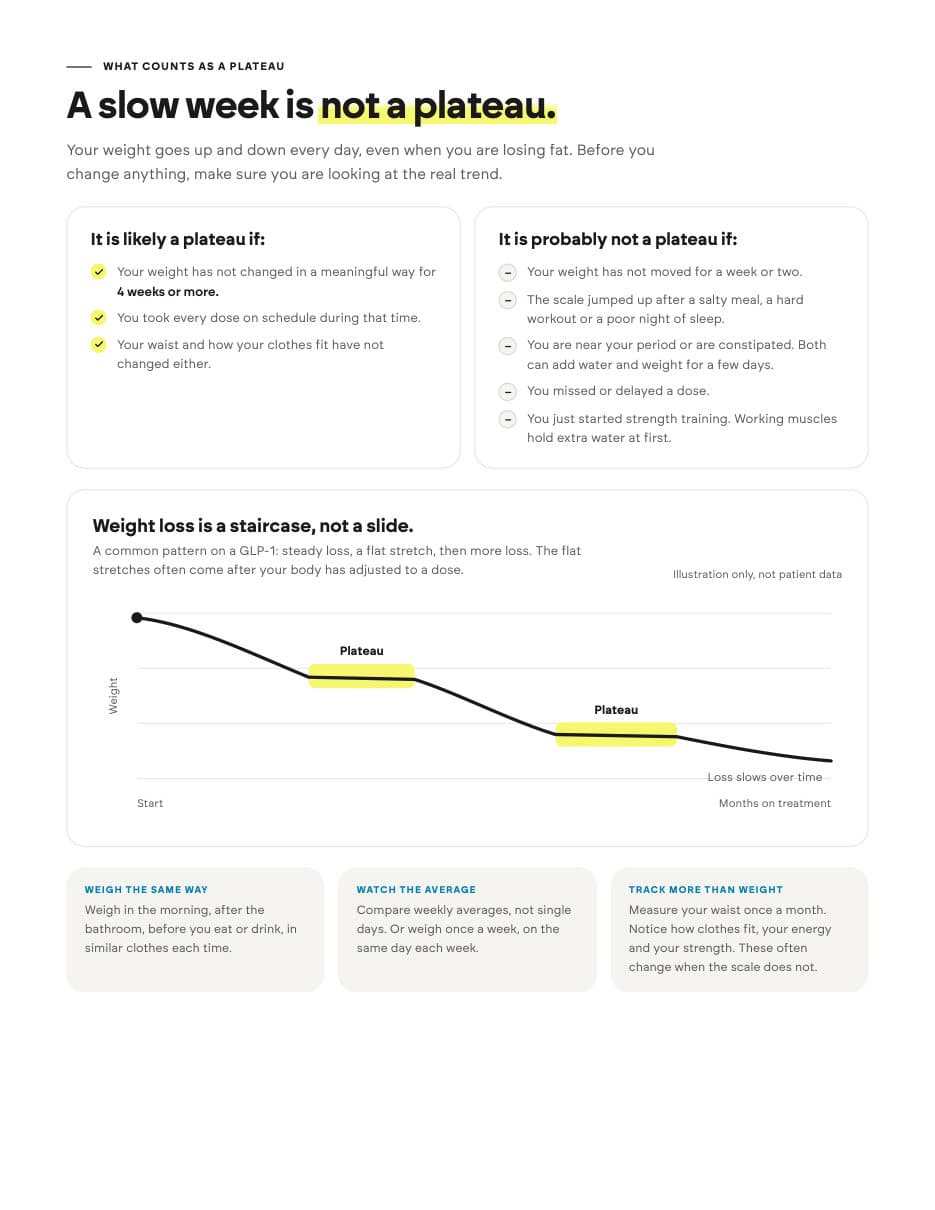
Your weight goes up and down every day, even when you are losing fat. Before you change anything, make sure you are looking at the real trend. Weight loss is a staircase, not a slide.
In the morning, after the bathroom, before you eat or drink, in similar clothes each time.
Compare weekly averages, not single days. Or weigh once a week, on the same day each week.
Measure your waist once a month. Notice how clothes fit, your energy and your strength.
You are eating less than before, so what you eat matters more than ever. Small, steady changes here are the first and best way to get the scale moving again.
Often missed
It sounds backwards, but eating too little can stall your progress. GLP-1s can quiet your appetite so much that some people get through most of the day on a few bites. Too little food for too long can break down muscle, slow how much energy you burn, and leave you too tired to move. Eat on a schedule, even if you are not hungry: try 3 small meals plus 1 or 2 snacks.
Protein helps you keep muscle while you lose fat, and it keeps you full longer. Eat the protein on your plate before the rest.
Portions and snacks creep up slowly. A short, honest food log for 3 to 7 days often shows what changed, or that you are eating too little.
Vegetables, fruit, beans and whole grains add volume for few calories. Fill half your plate with vegetables, and add fiber slowly with plenty of water.
Liquid calories add up fast and do not keep you full. Swap sweet coffee drinks and soda for water or unsweetened tea, and cut back on alcohol.
Build a meal
0 g
Many people aim for about 25 to 30 grams of protein at each meal. Pick what you might eat at your next one.
Amounts are approximate. Your care team can give you a daily protein target that fits your body.
When you lose weight, some of it comes from muscle. Muscle keeps you strong and burns more energy than fat, even at rest. Holding on to it is one of the best ways to keep losing.
Work your legs, hips, back, chest, shoulders and arms. Start with chair squats, wall push-ups and glute bridges. You do not need a gym.
Find your daily average, then add 1,000 to 2,000 steps. A 10-minute walk after meals can also ease fullness.
That is the weekly goal for moderate activity, like brisk walking, cycling or swimming. Ten-minute pieces count.
When you start lifting, your muscles hold extra water as they recover. Your weight may hold steady for a week or two while you are making real progress. Check your waist and how your clothes fit.
Talk to your care team before you start if you have heart, lung, joint or balance problems, or have not been active in a long time. Start light and build slowly.
GLP-1s can dull your thirst along with your hunger, so many people drink less than they realize. Low fluids can leave you tired, constipated and snacky, and all three can stall your progress. A good starting goal is 64 ounces or more a day.
Feeling snacky between meals? Drink a glass of water and wait 15 minutes. You may find you were thirsty.
A salty meal can add water weight overnight. It is not fat, and it usually passes in a day or two.
Short sleep raises hunger hormones and cravings. Aim for 7 to 9 hours. A walk or a few slow breaths can ease stress.
Constipation is common on a GLP-1, and a backed-up gut can add pounds on the scale. Read the constipation guide
If you have used these steps for 4 weeks or more and your weight still has not moved, it may be time to review your plan with your Belle clinician. GLP-1 doses go up in steps. A higher dose may help, but it is not right for everyone. Your clinician will look at your whole picture before making a change.
Food noise means constant thoughts about food: what to eat next, cravings, snacking when you are not hungry. When a GLP-1 is working, many people say it goes quiet.
A dose increase can bring back side effects like nausea for a few days. See the nausea guide.
Already at your highest dose?
You still have options. Your clinician can review your plan, talk about other treatments, or help you shift to keeping off the weight you have lost. Holding steady at a healthier weight is a real success.
Start at the top and give each change a few weeks to work. This is a general plan. Your care team may give you one that fits you better.
Weigh the same way each time and compare weekly averages. Measure your waist. Give it 4 weeks before you call it a plateau.
Eat 3 small meals and 1 or 2 snacks, even when you are not hungry. Aim for 25 to 30 grams of protein at each meal. Log your food for a week.
Strength train your whole body 2 to 3 times a week. Add 1,000 to 2,000 steps a day and build toward 150 minutes of activity.
Drink at least 64 ounces of fluid. Sleep 7 to 9 hours. Find small ways to ease stress.
Ask whether a dose increase is right for you. Your clinician can also check for other causes and adjust your plan.
The guide also has a protein food list, a sample day of meals and a sample week of workouts. Get the guide
“Weight loss is a staircase, not a slide.”
Thinking about a GLP-1, or want care that answers when your progress stalls? Start your online visit in a few minutes. A licensed provider reviews it and decides what is right for you.
Your offer
15% off your first order
Already applied when you start from the button below. Code GUIDE15 applies to your first order only; renewals are billed at the regular price.
Prefer to talk first?
Want some help getting started?
Book a free call with our team. Ask how Belle works, what it costs, and whether it is a fit for you. No pressure.
Book a free callCompounded medications are not FDA-evaluated for safety or effectiveness. GLP-1 medications are not recommended for individuals with a personal or family history of medullary thyroid carcinoma (MTC) or Multiple Endocrine Neoplasia syndrome type 2 (MEN 2). Not suitable for type 1 diabetes. Results may vary. All prescriptions are issued by licensed healthcare providers. Belle Health is not a pharmacy. This information is not medical advice.