
Your stomach empties slower
Food sits in your stomach longer. If you eat the way you used to, your stomach can get too full, and that feels like nausea.
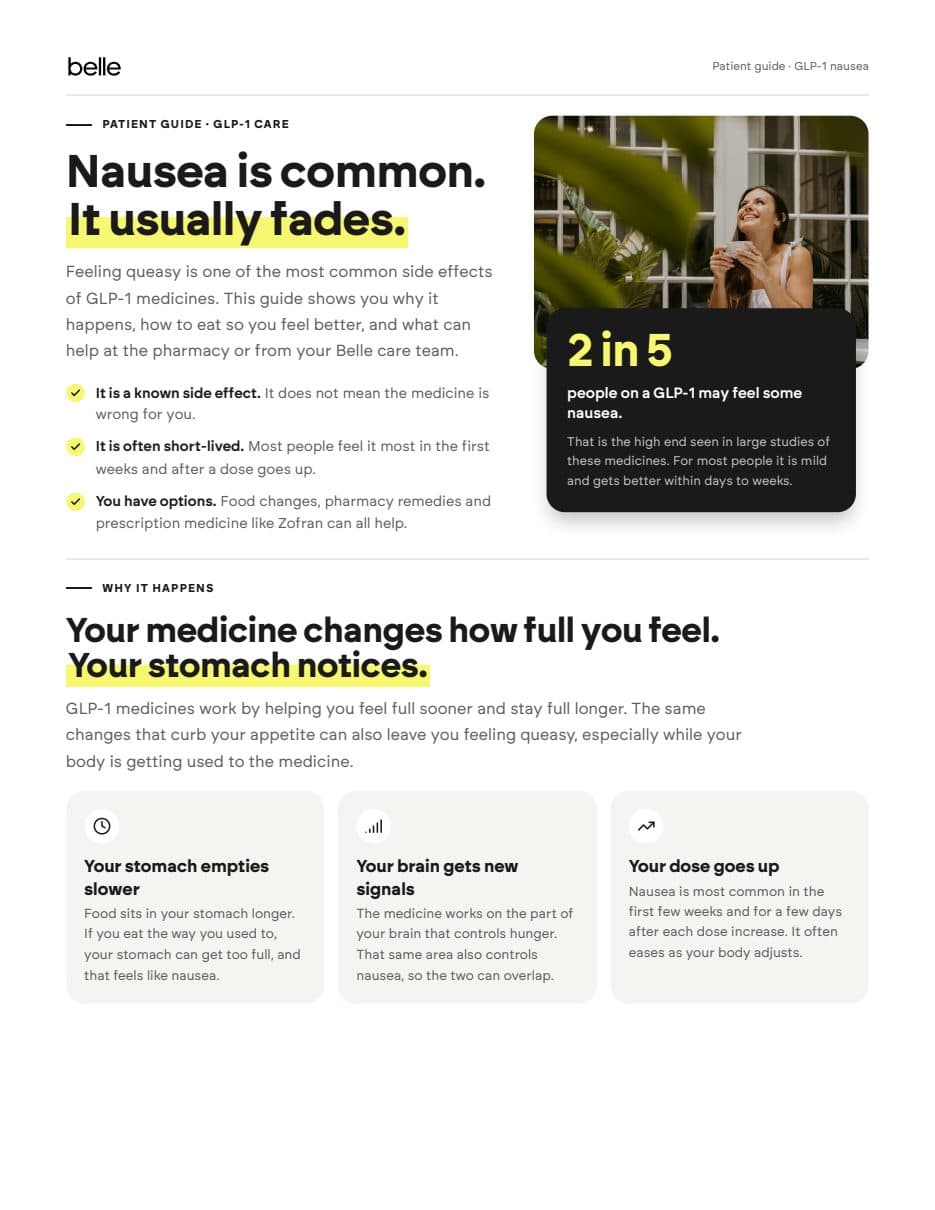
Feeling queasy is one of the most common side effects of GLP-1 medicines. This guide shows you why it happens, how to eat so you feel better, and what can help at the pharmacy or from your Belle care team.
Enter your email and we'll send the PDF straight to your inbox.

Tiffany Bailey, PA-CDirector of Patient Education, Belle
GLP-1 medicines work by helping you feel full sooner and stay full longer. The same changes that curb your appetite can also leave you feeling queasy, especially while your body is getting used to the medicine.
Food sits in your stomach longer. If you eat the way you used to, your stomach can get too full, and that feels like nausea.
The medicine works on the part of your brain that controls hunger. That same area also controls nausea, so the two can overlap.
Nausea is most common in the first few weeks and for a few days after each dose increase. It often eases as your body adjusts.
How you eat matters as much as what you eat. Your stomach now holds food longer, so it needs less at a time. These habits are the first and best way to ease nausea.
Try 4 to 6 small meals or snacks a day instead of 3 large ones. Start with half your usual portion.
Take about 20 minutes for a meal. Stop at the first sign you are satisfied, not when you feel full.
An empty stomach can make nausea worse. A few bites of something plain every 3 to 4 hours keeps it settled.
Fatty and fried foods are the slowest to leave your stomach. Choose baked, grilled or steamed.
Drinking a lot with food fills your stomach faster. Sip small amounts all day, and aim for at least 64 ounces.
Lying down soon after a meal can push food and acid back up. Stay upright for 2 to 3 hours after eating.
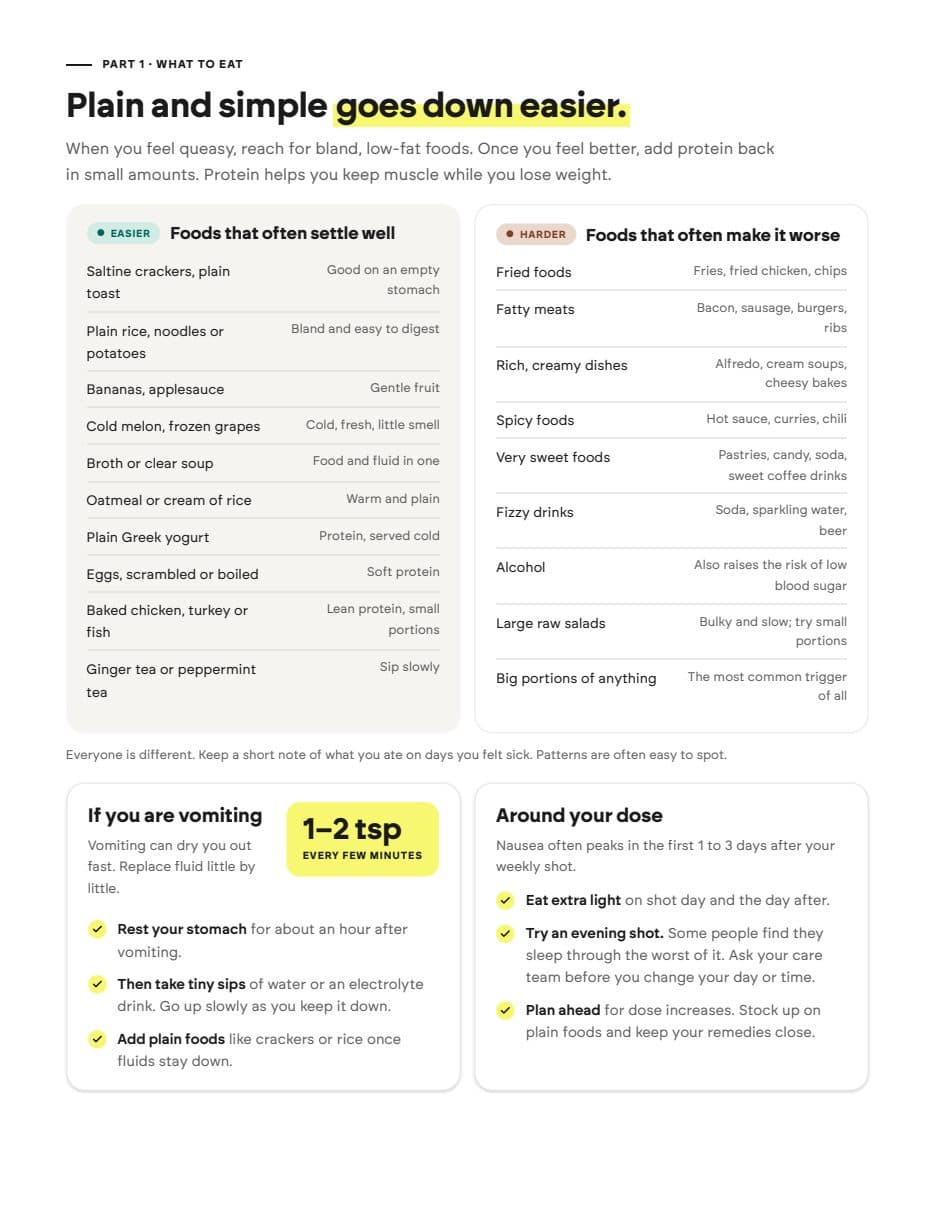
What to eat
Foods that often settle well
Foods that often make it worse
Everyone is different. Keep a short note of what you ate on days you felt sick. Patterns are often easy to spot.
If food changes are not enough, over-the-counter products can ease mild nausea. The guide shows you how to shop by the active ingredient, so you can buy the store brand, and what to watch for with each one.
Gentle · try first
Ginger, peppermint, acupressure wristbands and vitamin B6. Many people use these every day while they adjust to a new dose.
For heartburn or a sour stomach
If your nausea comes with heartburn or burping, calming the acid can calm the nausea too. Antacids work in minutes; acid reducers last longer.
Stronger · can cause drowsiness
Some people find these help GLP-1 nausea too. They can make you sleepy, so they are not a first choice.
Part 3 · Still feeling sick?
If nausea keeps you from eating, drinking or getting through your day, you do not have to push through it. Your Belle clinician can talk with you about prescription anti-nausea medicine, such as ondansetron, and may adjust your GLP-1 plan: keeping you at your current dose longer, moving you back to a lower dose for a while, or raising it in smaller steps. Never change your dose on your own.
Move to the next step only if the one before it has not helped. This is a general plan. Your care team may give you one that fits you better.
Small meals every 3 to 4 hours. Eat slowly and stop when you are satisfied. Go easy on fried, fatty and spicy food. Sip fluids between meals and stay upright after eating.
Try ginger chews or tea, peppermint, or acupressure wristbands. Keep plain crackers close by.
An antacid can give fast relief, and an acid reducer can help if it keeps coming back. The guide names what to look for on the label.
Ask about prescription anti-nausea medicine, or about changing your GLP-1 dose. You do not have to wait it out.
The guide also covers what to do if you are vomiting, and how to plan around shot day and dose increases. Get the guide
Most nausea can be handled at home. Some signs mean you need help from a clinician. Do not stop your GLP-1 on your own.
These can be signs of a problem with your pancreas or gallbladder, a blockage, or serious dehydration. Get care right away, and do not wait for a chat response.
“It is a known side effect. It does not mean the medicine is wrong for you.”
Thinking about a GLP-1, or want care that answers when side effects come up? Start your online visit in a few minutes. A licensed provider reviews it and decides what is right for you.
Your offer
15% off your first order
Already applied when you start from the button below. Code GUIDE15 applies to your first order only; renewals are billed at the regular price.
Prefer to talk first?
Want some help getting started?
Book a free call with our team. Ask how Belle works, what it costs, and whether it is a fit for you. No pressure.
Book a free callCompounded medications are not FDA-evaluated for safety or effectiveness. GLP-1 medications are not recommended for individuals with a personal or family history of medullary thyroid carcinoma (MTC) or Multiple Endocrine Neoplasia syndrome type 2 (MEN 2). Not suitable for type 1 diabetes. Results may vary. All prescriptions are issued by licensed healthcare providers. Belle Health is not a pharmacy. This information is not medical advice.