
Perimenopause isn't just hormones. It's a metabolic shift.
Most women are told their symptoms are stress, aging, or in their head. There is a clear physiologic explanation, and a growing set of evidence-based tools to address it.
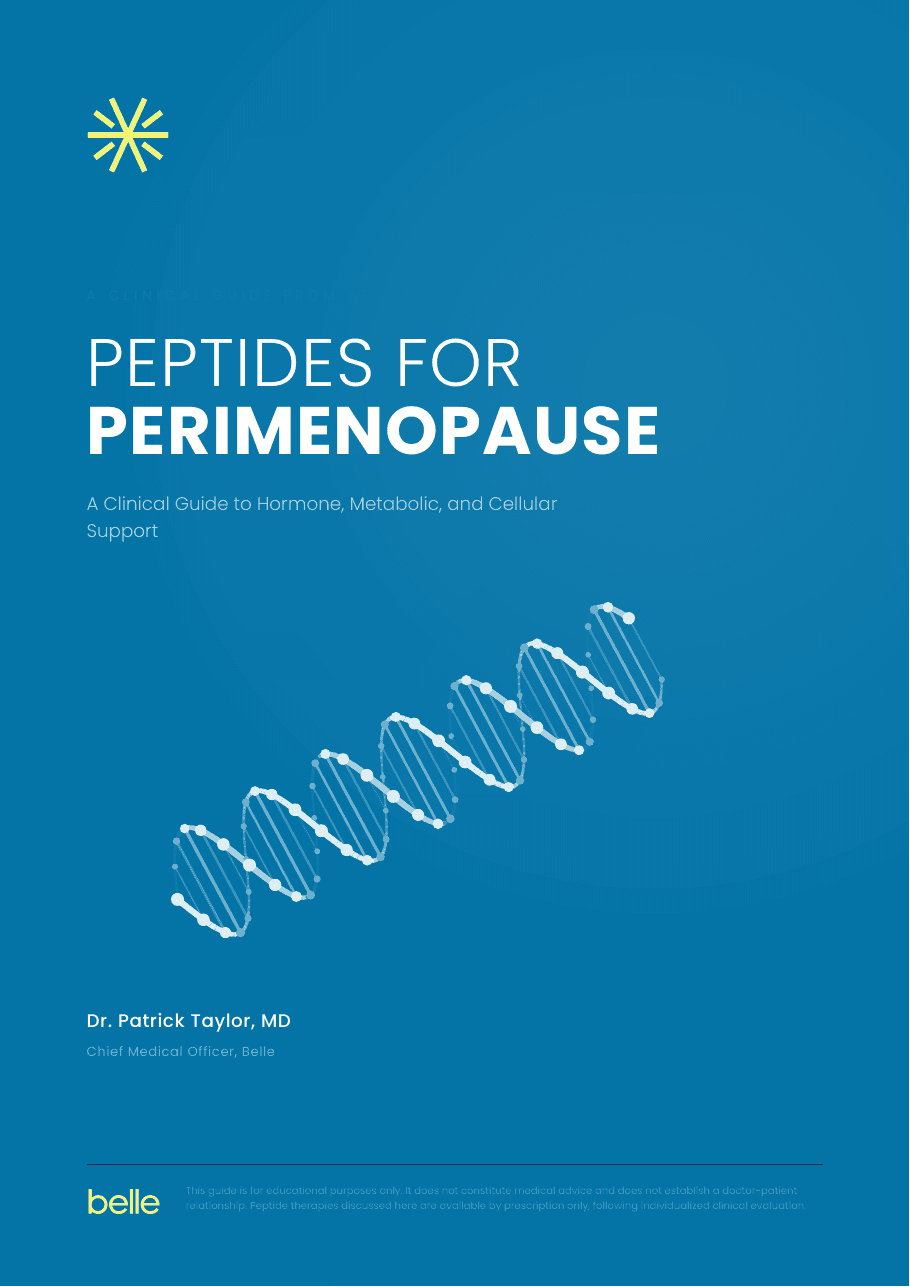
Send me the guide
Enter your email and we'll send the PDF straight to your inbox.
- Why labs often look "normal" while you feel anything but
- The four clinical buckets every symptom sorts into, plus a bonus fifth
- Which peptides are used in each bucket, ranked by real-world priority
- Where MHT fits, and what is genuinely additive to it

Dr. Patrick Taylor, MDChief Medical Officer, Belle · Menopause Society Certified Practitioner
- How long perimenopause can last
- 7–10 yrs
- Clinical buckets, fully mapped
- 5
- Major compound, with its mechanism
- Every
- Peer-reviewed citations
- 32
The symptoms nobody connects to perimenopause
Everyone knows the hot flashes. It's the second list that sends women to a psychiatrist, a rheumatologist, or a cholesterol-focused primary care visit instead of to anyone thinking about hormones.
What everyone expects
- Hot flashes
- Night sweats
- Sleep disturbances
- Vaginal dryness
What gets missed or misattributed
- Brain fog and word-finding difficulty
- Visceral belly fat, not just weight gain
- New or worsening anxiety and irritability
- New insulin resistance and elevated cortisol
- Joint pain and low libido
“Perimenopause is one of the most under-recognized transitions in medicine. Women are routinely told their symptoms are stress, aging, or in their head, when there is a clear physiologic explanation and, increasingly, evidence-based tools to address it.”
Every symptom sorts into one of five buckets
Most patients fit predominantly into one or two. The guide walks through each one: where it shows up, what it looks like on labs, and which tools are used, ranked by priority.
Insulin resistance
Where it shows up: New belly fat with no change in diet, rising A1c or cholesterol, sugar cravings, a family history of diabetes that seems to be catching up.
Tools the guide covers
GLP-1 receptor agonists (tirzepatide, semaglutide), MOTS-c, 5-Amino-1MQ, SLU-PP-332, AOD-9604
Systemic inflammation
Where it shows up: New joint pain or stiffness, histamine-type reactions, gut symptoms that weren't there before, hot flashes that feel disproportionate.
Tools the guide covers
BPC-157 & TB-500, GHK-Cu, KPV, GLOW & KLOW blends, GH secretagogues
Hormone imbalance
Where it shows up: Low libido, poor sleep even without night sweats, loss of muscle tone, mood changes. MHT is the foundation. This covers what is additive to it.
Tools the guide covers
Tesamorelin, CJC-1295 & ipamorelin, sermorelin, kisspeptin, PT-141
Cellular & mitochondrial
Where it shows up: Persistent fatigue that doesn't track with sleep, brain fog, slower recovery from exercise or illness, a sense of aging faster than your peers.
Tools the guide covers
NAD+, glutathione, SS-31, MOTS-c, 5-Amino-1MQ
Skin & longevity
Where it shows up: Skin thinning, dryness, and loss of elasticity are visible signs of the same estrogen decline driving everything else, not a separate system.
Tools the guide covers
NAD+, glutathione, GH secretagogues, epitalon, GHK-Cu
Not sure which one is you? The closing chapter is a self-sorting guide. Get the guide
Written the way he practices: evidence first, no hype
- 1
The physiology, explained plainly
Why estrogen fluctuates rather than declining in a straight line, and why that makes a single lab draw so misleading.
- 2
Mechanism for every compound
Not a list of names. What each peptide does, where the evidence sits, and honest notes on what isn't proven yet.
- 3
Clinical notes from real practice
Including the lean-muscle question with GLP-1s, the cortisol–insulin feedback loop, and muscle as an organ of longevity.
- 4
Where MHT fits, stated directly
Menopausal hormone therapy is the foundation of perimenopausal care, not an alternative. Everything else is additive.
- 5
32 peer-reviewed citations
Every claim is referenced, so you can take the guide to your own physician and have a real conversation.
Dr. Patrick Taylor, MD
Board-certified family medicine physician and Chief Medical Officer of Belle, where he leads protocol development for women's hormone and metabolic care nationally.
“I had cancer as a child, a year of chemotherapy followed by Cushing syndrome from the corticosteroids used to treat it. I was close to 300 pounds starting medical school, and lost 100 pounds through diet and training. That personal history is a large part of why I practice the way I do: I don't believe in shortcuts, and I don't believe in dismissing a patient's symptoms because the labs look normal.”
- Trained at the University of North Carolina at Chapel Hill
- Family medicine residency, University of Utah
- Menopause Society Certified Practitioner
- Focus on hormone optimization, peptide therapy, metabolic health, and longevity
Questions, answered.
Get the guide, free.
A clear map of what's actually happening in your body, fully referenced, from a physician who doesn't dismiss symptoms because the labs look normal.
Email me the guideEducational only. Not medical advice. Prescription therapies require individualized clinical evaluation.